Squat Rack Half Rack | Comparing Half Rack vs Full Power
Optimizing SKU Breadth and Inventory Turnover for Distributors
Many distributors mistakenly overstock heavy power racks, sacrificing warehouse utility for a single high-ticket item. A smarter procurement strategy leverages the squat rack half rack to balance high-demand utility with a leaner strength training equipment footprint, ensuring capital isn't locked in low-velocity inventory.
Maximizing Revenue per Square Foot
From a logistics standpoint, the commercial squat rack specifications for a half rack allow for more efficient container loading and reduced shipping volumes compared to full cages. By prioritizing these units, distributors can increase their SKU breadth without expanding warehouse footprints, effectively boosting inventory turnover. This approach optimizes the space-to-revenue ratio, allowing wholesalers to fulfill orders for boutique studios and multi-site rollouts with higher frequency and lower overhead costs.
Cost-Benefit Analysis: Capex vs. Long-Term Utility
When planning a multi-site rollout or managing a warehouse, the decision between a half rack and a full power rack hinges on the balance between initial acquisition costs and the total cost of ownership (TCO). While full racks offer maximum safety features, the half rack provides a more aggressive ROI for facilities where gym floor plan optimization is critical for maximizing member capacity.
| Evaluation Metric | Half Rack Configuration | Full Power Rack Configuration |
|---|---|---|
| Initial Capex | Lower; optimized for volume orders | Higher; premium pricing per unit |
| Footprint | Minimal; ideal for high-density layouts | Substantial; requires dedicated zones |
| Versatility | High; easily integrates with various attachments | Extreme; complete structural enclosure |
| Shipping Volume | Efficient; lower dimensional weight/CBM | Bulky; higher logistics and freight costs |
| TCO Profile | Lower maintenance and lower replacement risk | Higher long-term investment in structural rigidity |
For distributors, sourcing half racks often yields a better margin-to-volume ratio. Because these units occupy less space, you can maintain a more diverse inventory of accessories and attachments, driving higher add-on sales and improving overall equipment utility across your client base.
Strategic Sourcing and MOQ Management
Optimizing B2B sourcing requires a granular understanding of how shipping volume impacts your landed cost. Unlike full power racks, which often demand high minimum order quantities (MOQ) due to their sheer scale and structural complexity, the squat rack half rack offers greater flexibility for tiered procurement. Because these units have a more compact profile, distributors can achieve higher container density, significantly improving logistics efficiency during international transit.
When negotiating with factories, prioritize suppliers that offer modular components. This allows for better warehouse optimization, as you can stock essential parts and uprights separately to manage MOQ thresholds without overextending your storage capacity. A streamlined B2B sourcing strategy for half racks enables you to maintain a high-velocity inventory that responds quickly to market shifts while keeping freight-related overhead low.
Spatial Efficiency and Gym Floor Plan Optimization
Selecting a squat rack half rack configuration is a strategic decision for facility managers prioritizing high-density layouts. Unlike full power racks, which require a complete perimeter, the half rack design offers a significant reduction in the total footprint, allowing for more efficient gym floor plan optimization in high-traffic zones.
Maximizing Throughput in Commercial Gym Settings
In many commercial gym settings, square footage directly correlates to revenue potential. By utilizing a squat rack half rack, distributors and gym owners can increase the number of available lifting stations within a fixed area. This spatial advantage is particularly critical for boutique strength studios or multi-site rollouts where maximizing the density of strength training equipment without sacrificing structural integrity is a primary procurement goal.
Technical Dimension and Footprint Comparison
When conducting a facility audit, procurement specialists must evaluate the precise commercial squat rack specifications regarding depth and clearance. While a full power rack provides a 360-degree safety perimeter, a half rack allows for an open-access approach, which significantly alters the strength training equipment footprint and surrounding user lanes. This distinction is vital when calculating the total square footage required for safe weight plate loading and barbell rotation.
| Dimension Metric | Half Rack Configuration | Full Power Rack Configuration |
|---|---|---|
| Typical Depth Requirement | 42" – 50" (Open Front) | 60" – 84" (Enclosed) |
| Floor Space Utilization | High (Optimized for density) | Moderate (Requires clearance) |
| Access Direction | Single-sided / Frontal | Multi-directional / Perimeter |
| Installation Complexity | Lower (Often bolt-down only) | Higher (Structural stability focus) |
For distributors managing large-scale shipments, the reduced volume of half racks often translates to more efficient container utilization and lower shipping costs per unit compared to full-sized enclosures.
Scalability and High-Density Training Zones
For multi-site rollouts, the versatility of a half rack facilitates rapid scalability. Facility managers can deploy modular training zones that adapt to evolving member needs without the heavy structural overhead of full cages. This approach allows for high-density training clusters that maintain professional commercial squat rack specifications while keeping the gym floor plan optimization goals achievable across diverse facility footprints.
Structural Integrity and Commercial Squat Rack Specifications
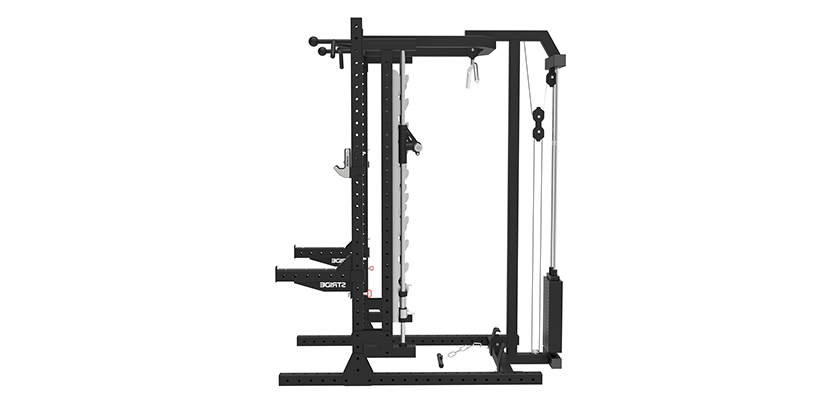
A high-performance squat rack half rack must balance a reduced footprint with uncompromising structural stability. For multi-site rollouts or high-traffic training centers, durability is determined by the gauge of the steel and the precision of the weld points, ensuring the frame remains rigid under heavy barbell oscillations.
Material Standards for High-Traffic Environments
When sourcing for commercial gym durability, the primary technical indicator is the steel gauge. We recommend specifying 11-gauge (approximately 3mm) steel for the uprights to prevent deformation during intensive strength sessions. While a half rack offers more open space than a full power rack, the structural integrity depends heavily on the base width and the quality of the cross-members. In high-traffic environments, the connection points must be engineered to withstand lateral forces, ensuring long-term utility and reducing maintenance-related downtime for facility managers.
| Procurement Factor | Standard Half Rack | Premium Commercial Half Rack |
|---|---|---|
| Steel Specification | 12-gauge steel | 11-gauge heavy-duty steel |
| Structural Profile | Standard uprights | Reinforced corner welds |
| Long-term TCO | Lower initial cost | Lower replacement frequency |
| Usage Suitability | Boutique/Studio | High-volume commercial gym |
From a procurement standpoint, opting for higher-spec steel minimizes the total cost of ownership (TCO) by extending the equipment lifecycle. Distributors should prioritize units with reinforced base frames to ensure the squat rack half rack remains stable even when utilizing heavy weight increments in high-density layouts.
Technical Comparison: Footprint vs. Structural Capacity
Optimizing a gym floor plan requires a precise understanding of how different rack architectures impact available square footage and total weight capacity. While a full power rack provides maximum safety through a complete cage, it demands a larger footprint and higher overhead clearance. Conversely, a half rack maximizes space utility without sacrificing the core stability required for heavy compound movements.
| Technical Specification | Half Rack Configuration | Full Power Rack Configuration |
|---|---|---|
| Typical Footprint | Compact / Space-efficient | Large / Fixed footprint |
| Weight Capacity | High (Variable by base design) | Maximum (Structural cage support) |
| Gym Floor Plan Optimization | Ideal for high-density layouts | Best for dedicated strength zones |
| Structural Profile | Open-access / Lateral movement | Enclosed / High-safety ceiling |
When evaluating commercial squat rack specifications, procurement managers must weigh the benefits of an open design against the total volume of the equipment. For distributors focusing on boutique studios or multi-functional training facilities, the half rack offers a strategic advantage in maximizing revenue-per-square-foot through superior strength training equipment footprint management.
Quality Control and Long-Term Maintenance Standards
Reliability in heavy-duty equipment depends on more than just steel gauge; it requires rigorous inspection of surface treatments and assembly points. For distributors, verifying the quality of the powder coating is essential to prevent oxidation and chipping in humid gym environments. High-grade electrostatic powder coating ensures the frame resists sweat and chemical cleaners, preserving the aesthetic and structural integrity over time.
Beyond initial procurement, calculating the Total Cost of Ownership (TCO) involves assessing the maintenance cycle. Premium units with superior welding quality and precision-engineered bolt holes reduce the frequency of hardware tightening and frame adjustments. By prioritizing high-spec manufacturing, facility managers can minimize operational downtime and ensure the strength training equipment footprint remains a high-utility asset rather than a recurring maintenance liability.
Functional Versatility vs. Footprint Constraints
When planning a multi-site rollout or a boutique studio layout, the primary tension lies in the balance between equipment utility and available square footage. Selecting a squat rack half rack configuration allows operators to maximize throughput in high-traffic zones without the massive spatial tax of a full power cage.
Optimizing Facility Layout and Throughability
In a high-density commercial gym setting, every square foot impacts your ROI. While a full power rack offers maximum structural enclosure for heavy lifting, it often creates "dead zones" in a floor plan. Conversely, a squat rack half rack provides an open-access design that facilitates better gym floor plan optimization. This reduced strength training equipment footprint allows distributors and facility managers to increase the number of usable stations per 1,000 square feet, facilitating better movement flow and reducing the perceived density of the training floor.
| Configuration Type | Typical Footprint | Primary Advantage | Spatial Impact |
|---|---|---|---|
| Full Power Rack | High/Large | Maximum safety/enclosure | Fixed, high-density footprint |
| Half Rack | Moderate/Medium | Versatile accessory integration | Enhanced floor flow |
| Squat Rack (Open) | Low/Minimal | Maximum accessibility | Optimized for small studios |
For bulk procurement, weighing the footprint vs. utility ratio is essential. A half rack offers a strategic middle ground: it maintains the structural integrity required for heavy barbell work while remaining compact enough to prevent bottlenecks in crowded weight rooms.
Technical Comparison: Dimensions and Accessory Compatibility
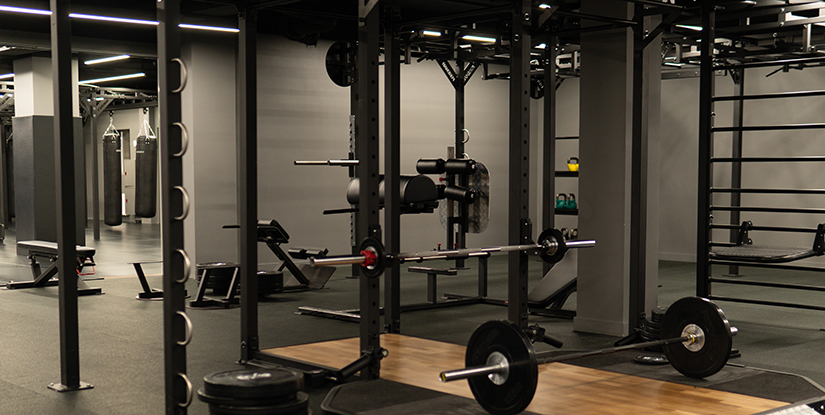
Procurement managers must look beyond the basic frame to evaluate the long-term utility of each unit. While a half rack reduces the total area occupied, it often compensates by offering a higher degree of modularity. When reviewing commercial squat rack specifications, ensure that the depth and accessory mounting points align with your facility's specific training programming to avoid underutilizing the equipment's potential.
| Metric/Feature | Full Power Rack Profile | Half Rack Profile |
|---|---|---|
| Average Depth Requirement | Extensive (Requires clearance for rear movement) | Streamlined (Optimized for front-facing access) |
| Accessory Compatibility | High (Often limited by internal cage geometry) | Very High (Easier attachment of dip bars, landmines, and pull-up bars) |
| Strength Training Equipment Footprint | Large/Fixed | Compact/Flexible |
| Installation Complexity | Higher (Often requires full structural anchoring) | Moderate (Often suitable for floor-mounted or modular setups) |
From a sourcing perspective, the squat rack half rack configuration offers a distinct advantage for distributors targeting boutique or high-density training centers. By selecting models with standardized hole spacing and high-grade steel gauges, you ensure that the smaller footprint does not sacrifice the durability required for heavy commercial use-cycles.
Strategic ROI: Scalability and Space-Efficient Training
For B2B decision-makers, the choice between rack types is a direct lever for long-term profitability. In boutique studios or high-density urban gyms, the ability to offer space-efficient training without sacrificing professional-grade durability is a critical competitive advantage. Investing in a squat rack half rack model often yields a higher ROI per square foot because it facilitates a higher density of high-value stations.
Distributor advice for multi-site rollouts often emphasizes scalability. Choosing modular half-rack systems allows for easier shipping logistics and more flexible facility layouts as your business grows. When sourcing, prioritize high-grade steel and standardized attachment points to ensure that your equipment remains versatile, even as the facility's programming evolves or the floor plan undergoes optimization.
Optimizing Freight Efficiency and Multi-Site Deployment
For distributors and large-scale gym operators, the selection of a squat rack half rack configuration is often a decision driven by logistics rather than just training utility. Because these units lack the secondary uprights and extensive cross-members of full power racks, they offer a significant reduction in shipping volume and total package count per unit.
When planning a multi-site deployment, these incremental savings in freight costs compound across dozens of locations. A half rack typically requires fewer specialized oversized shipping components, allowing for higher container density during sea freight. This footprint optimization extends beyond the gym floor to the supply chain, enabling procurement managers to satisfy commercial squat rack specifications while maintaining leaner inventory overhead and reducing the landed cost per unit.
Logistical Trade-Offs and Total Cost of Ownership (TCO)
Evaluating the structural trade-offs between these two configurations requires a granular look at how volume affects your landed cost. While a full power rack provides maximum stability and enclosure, it carries a higher logistical burden in terms of dimensional weight and assembly time. For high-volume distributors or multi-location rollouts, the following table highlights the typical differences in shipping density and operational requirements.
| Metric | Squat Rack Half Rack | Full Power Rack |
|---|---|---|
| Shipping Volume | Lower; optimized for higher container density | Higher; requires more cubic meter (CBM) per unit |
| Assembly Complexity | Streamlined; fewer components and uprights | Intensive; more structural members and fasteners |
| Strength Training Equipment Footprint | Compact; maximizes usable gym floor plan optimization | Expansive; requires larger clearance zones |
| Landed Cost Per Unit | Generally lower due to reduced freight weight | Higher due to increased shipping dimensions |
From a procurement standpoint, selecting a half rack configuration can significantly lower the barrier to entry for boutique studios or satellite gym branches where space is at a premium. By reducing the physical footprint and the complexity of onsite installation, you mitigate the risk of extended downtime during facility setup and lower the long-term maintenance overhead associated with complex structural assemblies.
Strategic Procurement and Inventory Management
Beyond freight, a critical procurement decision involves balancing scalability with inventory management. Choosing a squat rack half rack model simplifies the supply chain by reducing the number of unique SKUs and specialized components required for a single unit. This streamlined approach allows distributors to manage higher MOQ orders with lower risks of part shortages or mismatched batches.
For operators executing multi-site rollouts, the reduced assembly time translates directly into lower labor costs during the installation phase. By prioritizing equipment with fewer structural members, you can achieve better gym floor plan optimization while ensuring faster facility turnover. This efficiency is essential when managing rapid expansions or upgrading equipment across diverse locations with varying spatial constraints.
Optimizing Maintenance Cycles and Long-Term Utility
Managing a high-traffic facility requires a proactive approach to commercial gym maintenance to protect your initial capital investment. Because a squat rack half rack typically features fewer moving parts and a more open structural design than a full power rack, it often presents a lower long-term operational burden for facility managers.
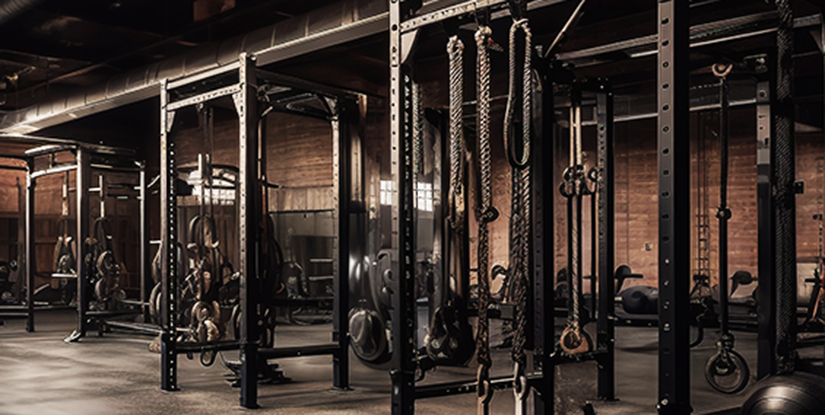
From a procurement standpoint, the reduced complexity of the squat rack half rack architecture minimizes the points of failure regarding adjustable pins and heavy-duty uprights. While all high-use strength training equipment experiences inevitable wear and tear on powder coatings and j-cups, the simpler geometry of a half rack simplifies routine inspections. This reliability is critical for maintaining structural integrity across multi-site rollouts, ensuring that facility management teams can focus on high-impact repairs rather than constant structural adjustments, ultimately lowering the total cost of ownership.
Technical Comparison: Maintenance and Durability Profiles
When calculating the total cost of ownership for multi-site rollouts, procurement managers must account for the frequency of component replacement. The following table illustrates the typical maintenance requirements and wear patterns observed in professional environments based on standard commercial squat rack specifications.
| Maintenance Factor | Half Rack Configuration | Full Power Rack Configuration |
|---|---|---|
| Primary Inspection Frequency | Quarterly (Visual & Structural) | Bi-Monthly (Full Structural & Safety) |
| Critical Component Wear | J-cups, Spotter Arms, Uprights | Pins, Safety Bars, Pull-up Bars, Uprights |
| Moving Parts Complexity | Low (Fewer adjustment points) | Moderate to High (More specialized hardware) |
| Typical Maintenance Burden | Minimal; focused on surface wear | Continuous; focused on safety/adjustment hardware |
For distributors and large-scale gym developers, choosing a half rack can streamline the logistics of spare parts inventory. Because the strength training equipment footprint is more open, accessing and replacing damaged J-cups or spotting arms is faster, reducing downtime during peak hours compared to the more complex mechanical systems often found in full power cages.
Strategic Sourcing for Long-Term ROI
To maximize the lifespan of your investment, focus on the foundational quality of the build during the procurement phase. High-tier distributors should prioritize sourcing high-grade steel with consistent wall thickness to prevent structural fatigue under heavy loads. Effective gym floor plan optimization is not just about the physical dimensions; it is about selecting equipment that withstands the friction of high-volume use without constant recalibration.
Implementing rigorous quality control (QC) protocols during the manufacturing stage ensures that every bolt, weld, and powder coating layer meets commercial standards. By selecting a squat rack half rack built from premium materials, you reduce the frequency of structural repairs and replacement-part orders. This proactive approach stabilizes your strength training equipment footprint and ensures high long-term utility, protecting your margins across multiple facility rollouts.
Strategic Sourcing: Selecting the Right Model for Your Client Profile
The decision to procure a squat rack half rack configuration over a full power rack is rarely about strength capacity alone; it is a calculation of revenue per square foot. For procurement managers, the goal is to balance equipment utility with a lean strength training equipment footprint to maximize throughput.
Optimizing ROI via Client-Specific Layouts
The ROI logic shifts significantly depending on the end-user environment. A boutique studio typically prioritizes high-end aesthetics and space-saving versatility to allow for multi-functional classes, making the half rack an ideal choice for gym floor plan optimization. Conversely, a large-scale commercial gym may prioritize the heavy-duty, enclosed safety of a full power rack for dedicated strength zones, despite the larger footprint.
| Profile Type | Primary Objective | Recommended Configuration | Space Efficiency |
|---|---|---|---|
| Boutique Studio | Versatility & Flow | Squat Rack Half Rack | High |
| Commercial Gym | Max Load & Safety | Full Power Rack | Moderate |
| Hotel/Apartment Gym | Footprint Minimization | Compact Half Rack | Very High |
Technical Specification and Cost-per-Square-Foot Analysis
When evaluating commercial squat rack specifications, buyers must account for the total cost of ownership beyond the initial unit price. This includes the physical footprint, potential accessory compatibility, and long-term maintenance requirements. While a full power rack offers a more enclosed safety profile, the half rack often provides a superior cost-per-square-foot ratio for high-traffic facilities where floor density is a priority.
| Metric | Squat Rack Half Rack | Full Power Rack |
|---|---|---|
| Typical Footprint | Compact / Open-access | Large / Enclosed |
| Versatility | High (Access from sides) | Moderate (Limited access) |
| Maintenance | Lower (Easier access) | Moderate (Component checks) |
| Revenue Potential | High (More units per area) | Lower (Higher area per unit) |
For distributors and large-scale procurement, selecting the half rack model often mitigates shipping volume costs and simplifies installation logistics. This makes it a highly scalable option for multi-site rollouts where consistency and space-efficiency are the primary drivers for long-term profitability.
Logistics and Total Cost of Ownership (TCO)
Beyond unit price, professional buyers must weigh the total cost of ownership (TCO) against long-term scaling capacity. A squat rack half rack typically offers a more favorable logistics profile due to reduced shipping volume and lower assembly complexity compared to full power racks. For distributors managing high-volume orders, this translates to lower freight costs and faster onsite setup. When scaling multi-site deployments, the decreased structural density of a half rack minimizes potential long-term maintenance overhead while maximizing the number of usable training stations within a fixed facility budget.