How to Choose the Best Power Rack for Kipping Pull Ups
Evaluating Long-Term Value: Rig Stability vs. Replacement Cycles
Many procurement professionals make the mistake of prioritizing low initial unit costs, only to face high replacement rates when lightweight structures fail under heavy use. A more sophisticated sourcing approach focuses on the total cost of ownership by investing in high-grade steel and superior gym rig stability from the start. While a cheaper unit might meet basic weight requirements, it often lacks the structural integrity necessary to withstand the repetitive, violent oscillations inherent in high-intensity training.
When searching for the best power rack for kipping pull ups, you must account for the massive kinetic energy generated during rhythmic swinging. Without advanced vibration damping capabilities and a heavy-duty frame, the constant lateral force can lead to bolt loosening, frame fatigue, and premature structural failure. By selecting equipment engineered for high-impact gymnastics, distributors and gym owners reduce long-term maintenance costs and extend the equipment's lifecycle, ensuring a much higher return on investment compared to budget-tier alternatives.
To make an informed purchasing decision, it is essential to visualize how different tiers of equipment perform over time. Selecting the best power rack for kipping pull ups requires a balance between your upfront budget and the frequency of high-intensity movements. A lower-tier rack may seem cost-effective initially, but the lack of a high-quality gymnastics pull up bar and heavy-gauge steel often results in a shorter replacement cycle due to structural fatigue.
The following table illustrates the typical trade-offs between investment levels and long-term reliability, helping you determine which category aligns with your facility's operational goals.
| Equipment Tier | Typical Use Case | Stability Level | Expected Lifespan | Maintenance Needs |
|---|---|---|---|---|
| Entry-Level | Home Gym / Light Use | Moderate | 2–4 Years | Frequent Bolt Inspection |
| Mid-Range | Boutique Studio | High | 5–7 Years | Occasional Tightening |
| Commercial/Pro | High-Traffic CrossFit Box | Maximum | 10+ Years | Minimal/Standard |
By analyzing these variables, buyers can better appreciate why a premium gym rig stability rating is a critical factor in long-term cost management rather than just an added expense.
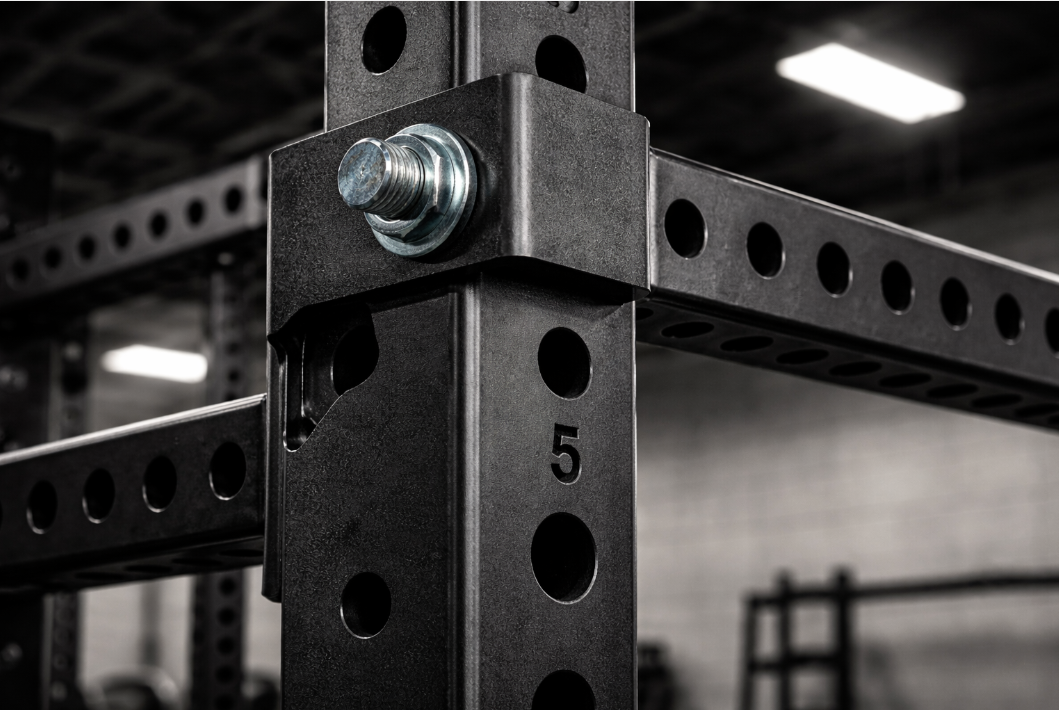
Beyond general stability, the technical specifications of the frame dictate how well the unit survives high-frequency oscillation. A critical factor in any crossfit equipment guide is the distinction between bolt-on vs. weld strength. While welding provides a seamless look, high-intensity movements demand high-grade fasteners and precision engineering to prevent the lateral shearing forces from loosening connections. We recommend prioritizing a high steel gauge—typically 11-gauge (3mm) or thicker—to ensure the frame possesses the necessary fatigue resistance to endure thousands of cycles without microscopic cracking.
Furthermore, the quality of the gymnastics pull up bar itself is a major determinant of long-term durability. A standard bar may suffice for static holds, but a specialized bar designed for dynamic weight shifts will resist bending and surface wear. When sourcing for commercial facilities, ensure the manufacturer utilizes high-tenseness steel that maintains its diameter under stress. Investing in these heavy-duty hardware features may increase the initial freight weight, but it significantly reduces the frequency of part replacements and ensures the best power rack for kipping pull ups remains a reliable asset for your clients for years to come.
Structural Integrity and the Physics of High-Intensity Movement
When sourcing high-performance training gear, many buyers overlook the violent physics involved in advanced calisthenics. Kipping movements are not static; they involve a rhythmic transfer of kinetic energy that places immense, unpredictable stress on a frame. As an athlete swings, they generate significant lateral force that pulls the structure away from its center of gravity. If a rig lacks sufficient mass or cross-bracing, this momentum can lead to micro-shifts or even structural failure over time.
This is why gym rig stability is the most critical metric for any facility manager. A standard rack designed for static lifting may buckle under the pendulum effect of a high-speed swing. To secure the best power rack for kipping pull ups, you must prioritize heavy-gauge steel and reinforced uprights. Without a design that accounts for these dynamic loads, you risk both equipment longevity and athlete safety during high-intensity sessions.
To withstand these dynamic loads, the foundational hardware must meet much higher industrial standards than standard residential gear. A professional-grade gymnastics pull up bar requires a frame constructed from high-density, heavy-duty steel. When evaluating a supplier's technical specifications, look specifically for a heavy steel gauge—typically 11-gauge (approx. 3mm) or thicker. This thickness is essential to prevent the structural deformation that occurs when repetitive, high-velocity swinging creates constant vibration and tension.
Beyond the thickness of the metal, the welding strength at every junction is what determines the long-term reliability of the unit. In our crossfit equipment guide, we emphasize that mediocre welds are the primary failure point in high-intensity environments. High-quality, continuous welds ensure that the uprights and crossmembers act as a single, rigid unit. This level of manufacturing precision minimizes wobbling and ensures that the rig remains perfectly aligned, even when subjected to the violent, rhythmic oscillations of advanced metabolic conditioning.
Selecting the right configuration involves balancing floor space against the required level of structural resilience. While a basic setup might suffice for low-impact training, high-volume facilities require a more robust architecture to handle the repetitive centrifugal forces of kipping. To help you determine the right investment for your facility, we have categorized common configurations based on their performance capabilities.
| Rig Type | Stability Level | Footprint | Movement Intensity |
|---|---|---|---|
| Standard Power Rack | Moderate | Compact | Static Lifting & Basic Pull-ups |
| Wall-Mounted Rig | High | Minimal | Standard Gymnastics & High-Rep Kipping |
| Full Modular Rig | Maximum | Large/Expansive | Professional Crossfit & Extreme Dynamic Loads |
When identifying the best power rack for kipping pull ups, consider that a Full Modular Rig offers the highest degree of gym rig stability due to its interconnected nature. While a Standard Power Rack is space-efficient, it may lack the lateral resistance needed for advanced athletes. For commercial distributors and gym owners, investing in a more expansive, heavy-duty system is often the most cost-effective way to ensure long-term durability and minimize maintenance downtime.
Selecting the Right Gymnastics Pull Up Bar for Dynamic Loads
When sourcing high-performance training gear, the primary concern for facility owners is often the long-term structural integrity of the equipment. Unlike standard strength training, kipping movements generate intense, rhythmic oscillations that test the limits of a frame. To find the best power rack for kipping pull ups, you must look beyond basic dimensions and focus on the physics of lateral force resistance. A lightweight or thin-walled rack will eventually succumb to metal fatigue or weld failure under these dynamic loads.
High-quality manufacturing requires heavy-gauge steel—typically 11-gauge (3mm) or thicker—and reinforced, full-penetration welding at all critical junctions. This level of construction ensures maximum gym rig stability, preventing the swaying or "walking" of the unit during high-intensity gymnastics sessions. For distributors and gym owners, investing in superior steel thickness is a proactive way to reduce maintenance costs and ensure user safety.
| Material Specification | Standard Strength Rack | High-Performance Gymnastics Rig |
|---|---|---|
| Steel Gauge | 14-gauge (Standard) | 11-gauge (Heavy-Duty) |
| Welding Type | Standard Spot Welding | Reinforced Full-Penetration |
| Dynamic Stability | Moderate (Static Loads) | High (Dynamic/Kipping Loads) |
| Durability Profile | Standard Commercial Use | High-Intensity/CrossFit Use |
Selecting a rig with these specifications ensures that your facility can handle the repetitive, multidirectional stress of advanced movements without compromising the gym rig stability required for professional-grade training.
Beyond the structural frame, the interface between the athlete and the equipment is critical. When evaluating a gymnastics pull up bar, the tactile specifications—specifically the grip diameter and bar texture—determine how well a user can maintain control during high-velocity swings. In our crossfit equipment guide, we emphasize that a bar which is too thin may cause hand fatigue, while one that is too thick can hinder grip transitions during rapid kipping cycles.
Different bar profiles serve distinct training purposes. A standard straight bar is excellent for traditional pull-ups and strict movements, but for high-frequency gymnastics, the texture and diameter must be optimized to handle sweat and rapid hand shifts. Below, we compare the most common configurations to help you decide which is the best power rack for kipping pull ups for your specific facility needs.
| Bar Type | Primary Benefit | Ideal Use Case | Stability Comparison |
|---|---|---|---|
| Straight Bar | Consistent grip surface | Strict pull-ups & Muscle-ups | High (Uniform Load) |
| Multi-Grip/Knurled | Enhanced friction/grip | High-intensity Kipping & RX | High (Optimized Friction) |
| Slim Diameter | Ease of rotation | Beginner/Intermediate training | Moderate (Variable Grip) |
For professional-grade facilities, we recommend prioritizing a gymnastics pull up bar with a knurled texture and a diameter between 28mm and 32mm. This ensures that even under heavy perspiration, the athlete maintains a secure connection, maximizing both performance and safety during dynamic oscillations.
Prioritizing Foundation and Anchor Integrity
While the upper frame handles the tension, the true test of long-term durability lies in how the unit interacts with the floor. High-intensity movements create rhythmic, shifting center-of-gravity changes that can cause even heavy rigs to creep or tilt if the foundation is insufficient. When sourcing the best power rack for kipping pull ups, do not overlook the baseplate design. A wider, more substantial footprint provides the necessary leverage to counteract the lateral energy generated during a swing.
For commercial operators, we highly recommend ensuring your selection includes robust floor anchoring capabilities. A rig that relies solely on its own weight is often insufficient for professional-grade gym rig stability during high-velocity sessions. Look for equipment that features pre-drilled mounting holes and high-tensile bolts. This structural connection to the ground is the most effective way to mitigate the risks of dynamic loads, ensuring your investment remains a stable, immovable fixture in your facility for years to come.
Optimizing Floor Space and Footprint for High-Volume Training
When sourcing high-performance equipment, many distributors overlook the critical relationship between a rig's physical footprint and the dynamic movement space required by athletes. Unlike static strength training, kipping movements generate significant lateral and longitudinal momentum. If you are selecting the best power rack for kipping pull ups, you must account for more than just the dimensions of the steel uprights.
A high-quality gymnastics pull up bar integrated into a heavy-duty rack requires a dedicated safety clearance zone to prevent collisions during high-intensity transitions. We recommend that facility owners and procurement managers evaluate the total "working area" rather than just the machine's base dimensions. Ensuring ample room around the rack prevents structural vibration issues and protects users from nearby obstacles, making it a vital consideration for long-term safety and high-volume throughput in professional training environments.
Selecting the right configuration is a balancing act between maximizing space efficiency and ensuring peak gym rig stability. Depending on your facility's square footage and the expected training intensity, the footprint of your equipment will dictate both the safety of the athlete and the longevity of the installation. Below is a comparison of common configurations to help you determine which setup aligns with your operational requirements.
| Configuration Type | Footprint Profile | Ideal Use Case | Stability Level |
|---|---|---|---|
| Standard Floor Rack | Large/Fixed | Dedicated CrossFit boxes or large training halls | Highest (Self-supporting) |
| Wall-Mounted Rig | Minimal/Compact | Boutique studios or limited square footage | High (Dependent on wall integrity) |
| Semi-Rigid/Modular | Variable/Adjustable | Multi-functional training zones | Moderate to High |
For high-volume centers, we often suggest a modular approach. While a wall-mounted setup offers the best space efficiency, a free-standing standard rack typically provides superior gym rig stability during the violent oscillations of a heavy kipping cycle. When sourcing, always verify that the mounting requirements for wall-based systems meet your local structural standards to avoid long-term maintenance issues.
Beyond the structural footprint, the ground beneath the rack is just as critical for maintaining high-volume training stability. The kinetic energy produced by a rhythmic kipping motion can cause micro-vibrations that, over time, may loosen bolts or compromise the leveling of your equipment. To mitigate this, professional-grade floor protection—such as high-density rubber matting or specialized impact tiles—is non-negotiable. This doesn't just dampen noise; it provides a stable foundation that absorbs lateral movement, protecting both the structural integrity of the rack and your facility's flooring.
As a key takeaway in our crossfit equipment guide, we advise procurement specialists to view the surrounding area as part of the equipment itself. A well-planned layout ensures that the best power rack for kipping pull ups operates in a controlled environment where the floor and the rig work in harmony to manage high-impact forces. By investing in high-quality flooring solutions alongside your rig, you reduce long-term wear and ensure a safer, more durable training experience for your members.
Sourcing High-Performance Crossfit Equipment Guide Standards
When sourcing for high-traffic facilities, the focus must shift from initial purchase price to long-term operational reliability. The dynamic load generated by kipping movements creates unique stress patterns that standard lifting rigs are not designed to handle. To ensure gym rig stability over years of heavy use, buyers must prioritize equipment built to resist structural fatigue. High-intensity swinging creates lateral forces that can eventually loosen connections if the manufacturing tolerances are not precise.
Maintaining the best power rack for kipping pull ups requires a proactive rather than reactive maintenance schedule. We recommend that facility managers implement a routine inspection protocol that includes regular bolt tightening to counteract vibration-induced loosening. Additionally, ensuring proper lubrication of any moving parts or adjustable components prevents premature wear. By investing in high-grade steel and rigorous quality control during the procurement phase, distributors can minimize downtime and ensure the safety of their end-users during high-velocity gymnastics sessions.
To safeguard your investment and ensure user safety, we have compiled a professional maintenance checklist. For high-intensity training environments, a safety check should not be an afterthought; it is a critical component of facility management. Because the gymnastics pull up bar experiences high-frequency oscillations, even minor structural shifts can become significant hazards if left unaddressed.
The following table outlines the recommended inspection frequency and essential maintenance tasks to maintain the integrity of your best power rack for kipping pull ups:
| Inspection Frequency | Maintenance Task | Focus Area |
|---|---|---|
| Weekly | Visual safety check | Check for loose bolts or visible structural shifts. |
| Monthly | Structural Integrity Audit | Tighten all connection points on the gymnastics pull up bar. |
| Quarterly | Surface & Coating Inspection | Identify any chips or signs of wear for rust prevention. |
| Bi-Annually | Deep Hardware Audit | Full torque check of all frame joints and base plates. |
Proactive rust prevention—such as wiping down steel components to remove sweat and moisture—is vital for extending the lifespan of your equipment, especially in humid training environments.
Ultimately, the most effective way to reduce replacement frequency is to prioritize material excellence during the procurement stage. This crossfit equipment guide emphasizes that the true cost of ownership is dictated by the quality of the raw materials used in construction. For instance, high-end rigs utilizing high-tensile steel are engineered to withstand the repetitive, high-impact oscillations inherent in kipping movements without suffering from permanent deformation.
Furthermore, the durability of the exterior finish is just as critical as the internal frame. A premium powder coating serves as a vital shield against the corrosive effects of sweat, humidity, and constant friction. Without a high-grade finish, the constant contact from hands and chalk can lead to rapid surface degradation, accelerating general wear and tear. By selecting equipment with superior metallurgical standards and robust coating processes, facility owners can ensure maximum longevity and a much higher return on investment for their commercial space.
Logistics and Assembly Realities for Large-Scale Rig Imports
When sourcing the best power rack for kipping pull ups, many distributors fail to account for the total landed cost beyond the initial factory invoice. Because high-performance rigs require heavy-gauge steel to ensure gym rig stability, you are not just importing equipment; you are importing significant weight and high shipping volume. This creates a high level of logistics complexity that can quickly erode your profit margins if not planned correctly.
Beyond ocean freight, professional buyers must budget for customs duties and local port handling fees, which vary significantly by region. A common mistake is focusing solely on the unit price of a gymnastics pull up bar or a single rack, while overlooking the volumetric weight costs of the entire shipment. To maintain a competitive edge in your crossfit equipment guide or local market, always request a comprehensive quote that includes estimated freight classes and potential import taxes to ensure your procurement budget remains intact.
To assist with your financial forecasting, we have outlined how different procurement scales impact your budget and delivery timelines. Whether you are a boutique studio owner or a large-scale distributor, understanding the relationship between volume and gym rig stability is essential for managing expectations.
| Procurement Scale | Primary Use Case | Typical Shipping Method | Estimated Lead Time |
|---|---|---|---|
| Individual / Boutique Studio | Small training spaces | LTL (Less Than Truckload) | 2–4 Weeks |
| Mid-Sized Fitness Center | Standardized gym layouts | Full Container Load (FCL) | 4–8 Weeks |
| Commercial Scale / Distributor | Large-scale facility builds | Bulk Ocean Freight | 8–12+ Weeks |
When ordering a high-spec gymnastics pull up bar in bulk, the savings on unit price are often offset by the specialized handling required for heavy steel components. For those following a professional crossfit equipment guide, we recommend planning for longer lead times to account for sea freight and local customs clearance, ensuring your facility launch stays on schedule.
Beyond logistics, the most significant hidden expense in large-scale procurement is the cost of onsite errors. When importing the best power rack for kipping pull ups, the complexity of the assembly dictates your final installation labor costs. If a shipment arrives with even minor discrepancies in hole alignment or bolt sizing, the resulting downtime can be devastating. This is why assembly precision is a non-negotiable requirement for high-intensity training rigs. A single misaligned component can compromise the structural integrity of the entire unit, making it unsafe for dynamic movements.
To mitigate these risks, we advise all professional buyers to prioritize suppliers that implement rigorous pre-shipment inspection protocols. Ensuring that every component of your gymnastics pull up bar and frame system is verified for dimensional accuracy before it leaves the factory is the most effective way to protect your bottom line. In any comprehensive crossfit equipment guide, the focus must shift from the lowest unit price to the total cost of ownership, which includes the reliability of the assembly process and the long-term gym rig stability of the finished installation.
Maximizing Long-Term ROI Through Structural Integrity
When sourcing equipment for high-traffic facilities, the best power rack for kipping pull ups is not merely the one with the lowest upfront price, but the one that offers the highest long-term ROI. In a commercial setting, the dynamic forces generated during high-volume gymnastics movements can quickly expose inferior builds. If a rig lacks sufficient gym rig stability, you will face frequent replacement cycles and increased maintenance labor, which silently erodes your profit margins.
True value lies in high-intensity usage durability. We recommend prioritizing heavy-gauge steel constructions and reinforced welding points that can withstand the lateral torque of constant swinging. Investing in a premium gymnastics pull up bar system with high structural integrity ensures that your facility remains operational without unexpected downtime. For distributors and gym owners, selecting a partner who understands these rigorous stress requirements means fewer warranty claims and a more reliable reputation in the fitness market. Focus on build quality today to avoid the high cost of replacement tomorrow.
To assist in your decision-making process, we have developed a comparison to help you determine which configuration aligns with your facility's specific training demands and budget. Choosing the wrong tier can lead to unnecessary capital expenditure or, conversely, a lack of safety during high-intensity sessions.
| Feature/Requirement | Standard Power Rack | Professional Gymnastics Rig |
|---|---|---|
| Primary Use Case | Strength training & basic calisthenics | High-volume CrossFit & gymnastics training |
| Stability Level | Moderate (Suitable for static loads) | Maximum (Engineered for dynamic lateral forces) |
| Typical Dimensions | Compact/Standard footprint | Expanded footprint for multi-station use |
| Ideal For | Boutique studios or home gyms | Commercial training facilities & CrossFit boxes |
| ROI Perspective | Low entry cost; higher long-term maintenance | Higher initial investment; superior durability |
When evaluating the best power rack for kipping pull ups, consider that a professional-grade rig acts as a permanent asset. While a standard setup may suffice for stationary movements, a specialized gymnastics pull up bar configuration is essential for maintaining gym rig stability during aggressive, rhythmic swinging. Selecting the appropriate tier based on your projected athlete volume will optimize your procurement strategy and long-term operational efficiency.
Finalizing your procurement requires moving beyond technical specifications to focus on operational reliability. To ensure your shipment arrives ready for high-impact training, your procurement checklist must include more than just steel gauge and dimensions. A professional crossfit equipment guide suggests that the most critical phase is the transition from the factory floor to your facility. Even the most stable gymnastics pull up bar loses its value if it arrives damaged or requires extensive on-site assembly due to poor packaging.
We advise all distributors to demand rigorous quality assurance protocols from their manufacturing partners. This includes verifying weld strength under dynamic load testing and ensuring the powder coating can withstand high-friction use. Furthermore, do not overlook shipping safety; high-density steel components require specialized crating to prevent structural warping during long-haul transit. By prioritizing a manufacturer with proven export expertise and strict oversight, you mitigate the risk of receiving substandard units, ensuring your investment in the best power rack for kipping pull ups delivers immediate, safe, and high-performance results for your athletes.